

Short names are finished. Google states that you can no longer create or edit a short name, that existing ones still work but are no longer shown on the profile to customers, and that once you delete yours you cannot create it again. So if you still have one, leave it alone. If you do not, there is nothing to set up, and the g.page link you may have printed on a card still resolves even though the feature is retired.
For a few years, the Google Business Profile short name was the tidy answer to an awkward question: what link do I give people to leave a review or find us on Google? Then it was quietly withdrawn.
It still comes up in checklists, agency audits and old blog posts, which is why it is worth being clear about what remains and what does not.
What a short name was
A custom name that gave your profile a memorable address. Google’s help page describes it: when you share your short name, customers can type the URL into the address bar and go straight to your Business Profile, in the form g.page followed by your custom name.
It was useful on business cards, email signatures, receipts and van livery, because it was short enough to read aloud.
What Google says now
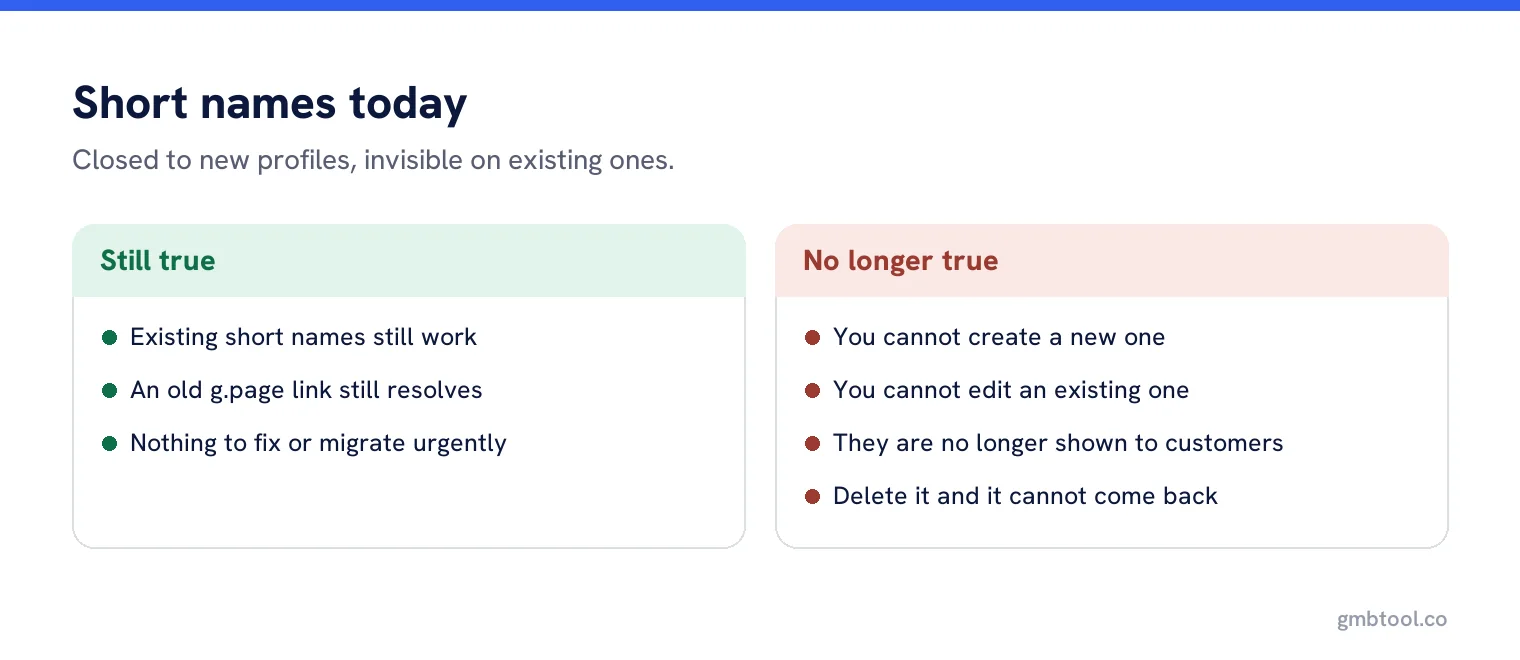
- You can no longer create or edit short names.
- Short names and URLs that already exist still work.
- They are no longer shown on the Business Profile to customers.
- If you delete your existing short name, you cannot create it again.
That last point is the one that matters most. Deleting is the only irreversible action available, and there is no reason to take it. If a short name sits on your profile doing nothing, leaving it costs nothing.
What to use instead
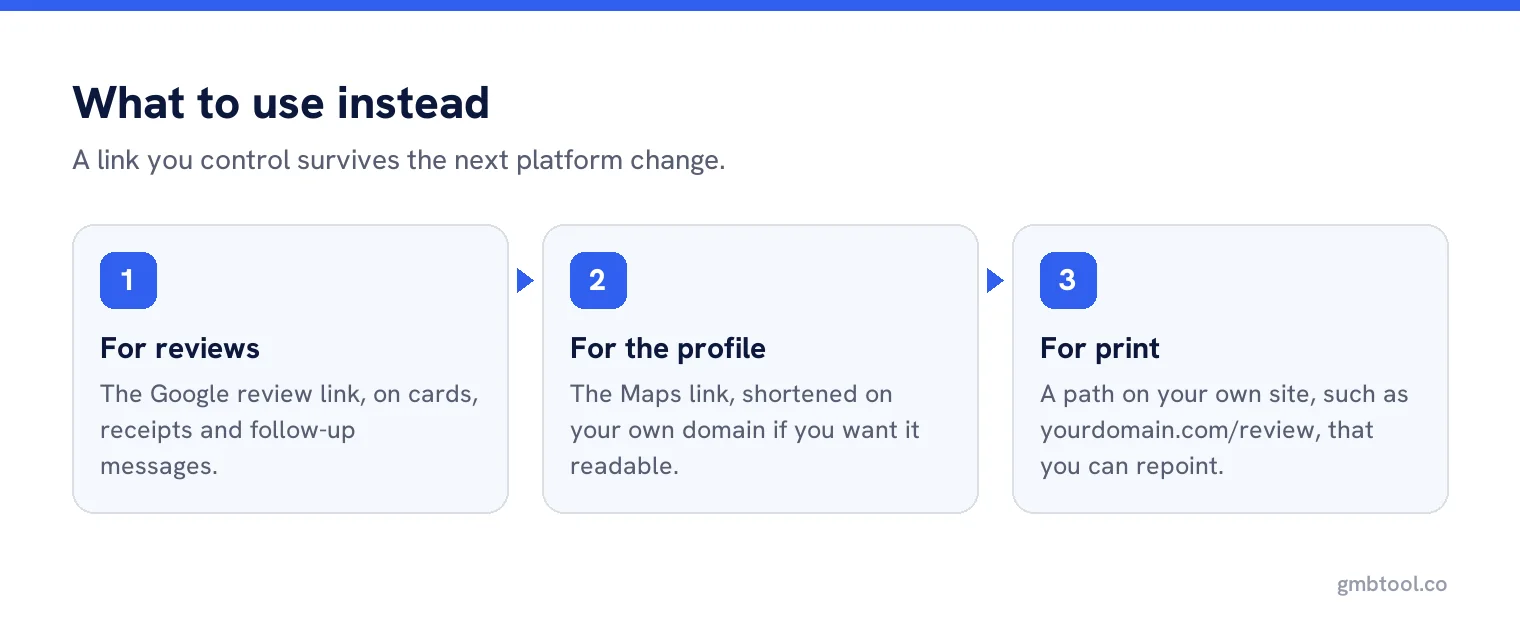
For reviews, the review link
Google provides a link that opens the review box directly. That is the one to put on cards, receipts and follow-up messages.
For the profile itself, the Maps link
Long and ugly, but stable. Shorten it with your own domain if you want something readable.
For print, your own short redirect
A path on your own site, such as yourdomain.com/review, that you control and can repoint whenever Google changes something.
The third option is better than the short name ever was, because it survives the next time a platform retires a feature. The only cost is five minutes with whoever manages the website.
Checking if you still have one
Open the profile editor and look for a short name field. If it shows a name, you have one from before the change. If it shows nothing, there is nothing to do and nothing you can do. Either way, no action is required, which makes this one of the few items you can strike off an audit checklist permanently.
Old material that still references it
Printed cards, old email templates and review request messages from before the change may contain a g.page link. Those still resolve, so there is no urgency, but the next time anything is reprinted it is worth switching to a link you control. A link on your own domain can be repointed; a g.page link cannot.
Setting up a link you control, properly
The pattern takes ten minutes per location and is worth doing once for the whole estate. Create a path on your own site for each location, point it at the Google review link for that profile, and record the mapping in the same sheet that holds your store codes. Print the path, never the destination.
Three details make it durable. Use a path a human can say out loud and type from memory, because that is the whole point. Keep the redirect server side rather than in a page of JavaScript, so it works when somebody scans a QR code on a train with one bar of signal. And check the destinations once a quarter, since Google occasionally changes the shape of its links and a broken review link is invisible until somebody tells you.
Done this way, the next platform change is a half hour of updating redirects rather than a reprint of ten thousand loyalty cards.
Why features like this get retired
Short names were a vanity layer on top of a record Google maintains, and they created duplication: two addresses for the same profile, one of which Google had to support indefinitely. The lesson for anyone building processes on a platform feature is the ordinary one. Anything you print, embed or give to customers should point at something you own, with the platform behind it.
What this does not affect
Short names never appeared in search results, never affected which searches a profile matched, and never carried any weight in how Google ranks local results. They were a shortcut for humans typing an address, nothing more.
None of the things that matter changed. Your profile still appears in Search and Maps, the review link still works, and your performance data is unaffected. The short name was a convenience, not a ranking feature, and its retirement does not require any compensating work.
What to tell a client who asks for one
They have usually read an old article, or a competitor has one and they want the same. The useful answer is three sentences: the feature is closed to new profiles, existing ones are not shown to customers any more, and the thing they actually want, a short link they can print, is better built on their own domain. Said that way it stops being bad news and becomes a small job with a better outcome.
A note for multi-location businesses
Groups that rolled out short names across an estate sometimes used them in regional print, local sponsorships or vehicle livery. Those links still work, but there is no way to create them for new sites, so a growing estate now has two classes of location. Standardising on your own domain with a location path, such as yourdomain.com/leeds, removes that split and is the only pattern that will still be true in five years.
Links your customers can actually use
Generate review links for every location and keep them in one place, ready for cards, emails and receipts.
Frequently asked questions
Can I still create a Google Business Profile short name?
No. Google states that short names can no longer be created or edited, and that existing ones are no longer shown on the profile to customers.
Do existing short names still work?
Yes. Google says short names and URLs that already exist will still work, so a g.page link printed on old material still resolves.
Should I delete my short name?
No. Deleting is irreversible and you cannot create another. If it is doing no harm, leave it in place.
What should I use instead?
The review link for review requests, the Maps link for the profile, and ideally a short path on your own domain that you can repoint whenever a platform changes.
Did losing short names affect my rankings?
No. It was a convenience feature, not a ranking one, and its retirement needs no compensating work.
Sources
The Google documentation behind the guidance on this page. Google changes these pages without notice, so check the date on any figure before you rely on it.